

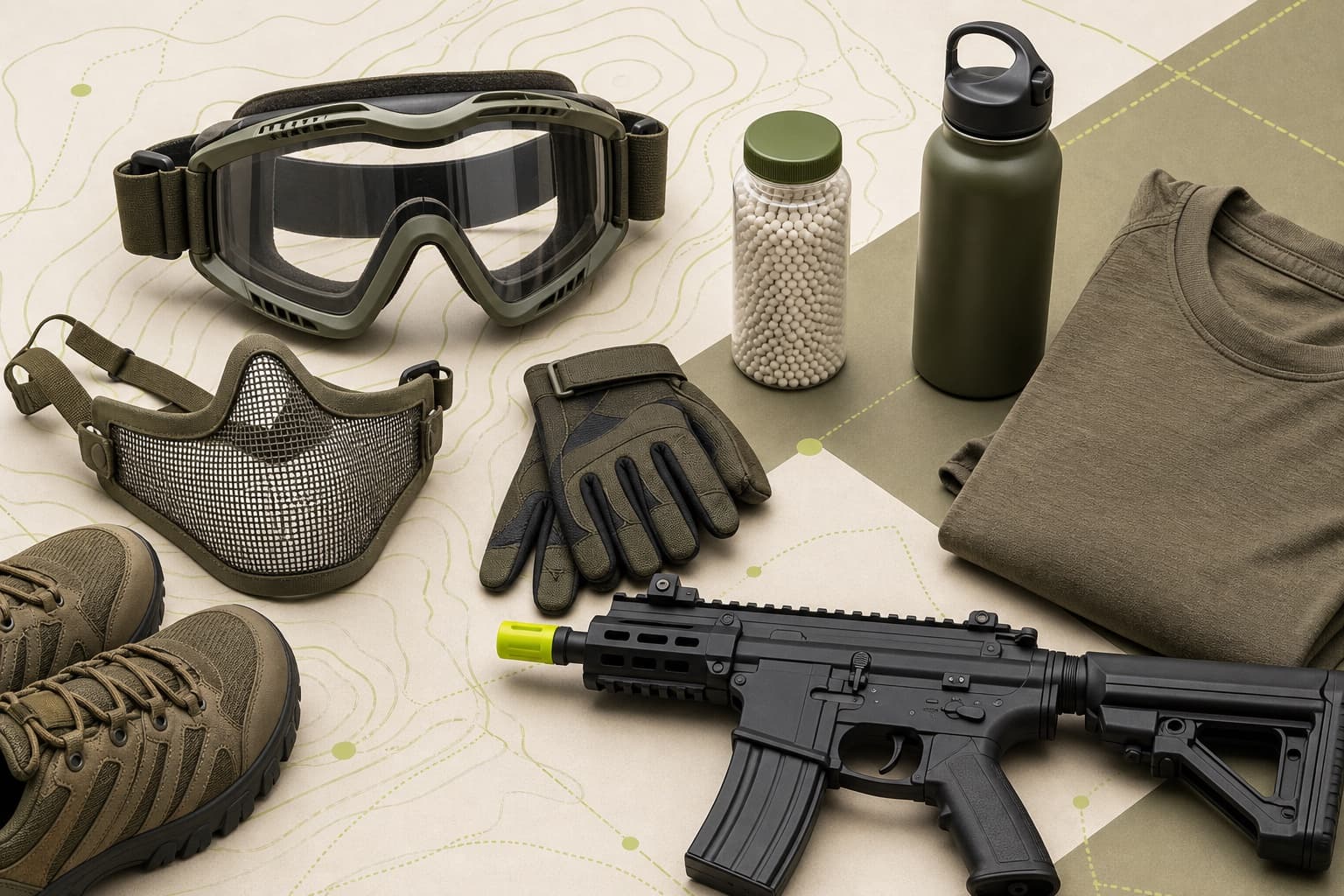
Safety first. Always check the field rules and organiser's instructions before buying or using any equipment.
Airsoft roles are not only a choice between rifleman, support gunner and sniper. Each function changes movement, ammunition load, engagement distance and, in some cases, the replica type accepted by the organiser.
Power limits cause frequent confusion. In Spain, players commonly quote 1.14 J for rifles, 1.49 J for support weapons, 1.88 J for designated marksman rifles and 2.81 J for bolt-action sniper rifles. These figures are widely used, but they are not a national statutory role table binding every field. They are game limits adopted by federations, associations and organisers, each of which may reduce them, alter minimum engagement distances or disallow a role.
This guide explains what each role does, which replicas normally fit it, the common limits found in Spain and why the specific event rules must always be checked before adjusting a replica.
Quick table of roles, joules and distances
This table uses the Spanish Airsoft Federation rules as a reference and compares them with Spanish field regulations. FPS values are approximate equivalents, rounded to the nearest whole number, for 0.20 g, 0.25 g and 0.28 g BBs. The meaningful limit is muzzle energy measured in joules under the organiser's chrono procedure.
| Role or replica class | Common maximum | FPS with 0.20 g | FPS with 0.25 g | FPS with 0.28 g | Common minimum distance | Typical replicas |
|---|---|---|---|---|---|---|
| Pistol or CQB secondary | 1.00 J | 328–330 FPS | 293 FPS | 277 FPS | 0–3 m | Glock, Hi-Capa, M9, P226, AAP-01 |
| SMG, shotgun or assault rifle | 1.14 J | 350 FPS | 313 FPS | 296 FPS | 0–5 m | M4, AK, HK416, G36, MP5, MP7, P90, ARP9 |
| Support machine gun | 1.48–1.49 J | 400 FPS | 358 FPS | 338 FPS | 15 m | M249, Mk46, M60, PKM, RPK, MG42 |
| Designated marksman or DMR | 1.88 J | 450 FPS | 402 FPS | 380 FPS | 20 m | SR-25, M110, SVD, M14, G3SG1, HK417, G28 |
| Bolt-action sniper | 2.81 J | 550 FPS | 492 FPS | 465 FPS | 25–30 m | VSR-10, L96, TAC-41, SRS, M40 |
These are common ceilings, not targets that every replica should reach. A well-tuned lower-energy replica can outperform a more powerful one with inconsistent air seal, poor hop or unsuitable ammunition.
As a practical buffer, a replica used under a 1.14 J field limit can be set around 1.05–1.10 J. Roughly 1.38–1.44 J for support, 1.70–1.82 J for DMR and 2.55–2.70 J for bolt action provide similar margins. These are not additional rules and never guarantee admission. If the field publishes a lower limit, the field limit always wins.
What Spanish law actually says
Spanish Order INT/2860/2012 defines airsoft sporting projectiles as weighing no more than 0.45 g, with a maximum diameter of 8 mm and muzzle energy no greater than 3.5 J. It also places these devices within category 4 of the Spanish Weapons Regulation according to their operating system.
That 3.5 J statutory ceiling does not grant permission to play at 3.5 J in every role. A field may enforce substantially lower limits because of safety, insurance, terrain design or organiser policy. A 3.2 J replica may sit below the order's ceiling and still be rejected from an event whose bolt-action limit is 2.81 J.
The Spanish Airsoft Federation publishes common rules for its member associations and as a reference for other organisers. Its table uses 1 J for pistols, 1.14 J for shotguns, SMGs and rifles, 1.48 J for support, 1.88 J for designated marksmen and 2.81 J for bolt action. These are federation and gameplay rules rather than a BOE statute automatically applying to every field.
Why Spanish fields can publish different limits
The differences are real. Federation rules normally use 3 m for pistols, 5 m for rifles, 15 m for support, 20 m for DMR and 30 m for bolt action. Campo Airsoft El Cortijo, however, allows zero distance for SMGs up to 1 J and rifles up to 1.14 J in its classic format while applying specific restrictions inside buildings. Its sniper ceiling remains 2.81 J but its minimum distance is 25 m rather than 30 m.
The Andalusian Airsoft Federation describes a 0.84 J CQB configuration, while other rules place zero-distance use near 1 J. La Fundición Airsoft, for example, publishes 1.01 J at zero distance for pistol, shotgun and SMG, and 1.14 J with 5 m for rifles.
Fire modes and accepted models vary too. Some sites are semi-only, some reserve automatic fire for support weapons, and others restrict bursts to two seconds. An organiser may require a secondary for specialist roles, a mechanically locked DMR selector, a lower BB weight or prohibit HPA. The only valid confirmation is therefore the rule set for the particular event.
Comparing joules, FPS and BB weight
FPS measures BB velocity. Joules measure the kinetic energy carried at the muzzle. Both velocity and mass are required:
Energy = ½ × BB mass × velocity²
An FPS figure on its own therefore does not describe power. “My replica shoots 330 FPS” could describe an approximately 1 J secondary or a replica exceeding a common rifle limit, depending on the projectile weight.
Same joules, different FPS
If energy remains exactly 1.14 J, a heavier BB must travel more slowly:
| BB weight | Velocity equivalent to 1.14 J |
|---|---|
| 0.20 g | 350 FPS |
| 0.25 g | 313 FPS |
| 0.28 g | 296 FPS |
All three rows represent the same muzzle energy. The 0.28 g BB is not less powerful because the chronograph reads 296 FPS: its greater mass requires less velocity to carry 1.14 J. Read the main table in the same way—horizontally, each row keeps joules constant while FPS falls as BB weight increases.
Same FPS does not mean the same joules
If velocity stays the same while mass increases, energy rises:
| Chronograph reading | Approximate energy |
|---|---|
| 350 FPS with 0.20 g | 1.14 J |
| 350 FPS with 0.25 g | 1.42 J |
| 350 FPS with 0.28 g | 1.59 J |
| 330 FPS with 0.28 g | 1.42 J |
| 300 FPS with 0.28 g | 1.17 J |
This is the common mistake. A replica producing 330 FPS with 0.28 g is not “below 350 FPS” when the published 350 figure assumes 0.20 g. It is producing approximately 1.42 J and exceeds a 1.14 J rifle ceiling. At 0.28 g, approximately 296 FPS is the equivalent of 1.14 J.
Does a heavier BB increase replica power?
The BB does not create energy. In an ideal system delivering a constant 1.14 J, changing from 0.20 to 0.28 g reduces velocity while muzzle energy remains 1.14 J. A heavier BB normally retains velocity and energy better in flight and is less affected by small disturbances, but it requires sufficient hop and the field may restrict BB weight.
Real replicas do not always maintain identical energy across weights. A heavy BB remains in the barrel longer, allowing some systems to push it for more time. When measured joules rise with BB weight, this is joule creep. It is closely monitored in GBB, HPA and high-cylinder-volume builds, although it can occur in other systems. The opposite can also happen when cylinder volume, air seal or barrel length is unsuitable.
How to compare a chrono reading correctly
- Enter the actual BB weight into the chronograph. If it is set to 0.20 g while you fire 0.28 g, the displayed joules are wrong.
- Use the game hop setting and the same gas, pressure, nozzle or regulator.
- Read joules directly when the chronograph has the correct mass configured.
- If only FPS is available, use the column for that BB weight or convert the reading.
- Compare joules with the field ceiling. Never compare your FPS with a number published for a different weight.
For a manual calculation, divide grams by 1,000 to obtain kilograms and multiply FPS by 0.3048 to obtain metres per second. For example, 330 FPS is 100.58 m/s; with 0.28 g the calculation is ½ × 0.00028 × 100.58² = 1.42 J.
The reliable method is to chrono with the BB used during play and the hop adjusted. Both the Spanish and Andalusian federation rules describe checks using the declared game ammunition. Do not change gas, regulator, spring, nozzle, BB or power setting after chrono without telling the organiser. The field chronograph and its reading decide whether a replica enters the game.
Rifleman or assault: the versatile role
The rifleman moves with the team, takes positions, covers advances and works at short and medium distance. It is the most flexible role and normally the best starting point because it teaches movement, communication and realistic range without a specialist replica.
Common platforms include M4/AR-15, AK, G36, HK416, SCAR-L, AUG and FAMAS. They may be AEG, GBBR or HPA where that system is permitted; propulsion does not by itself change the power class.
Examples in our catalogue include the Tokyo Marui M4A1 MWS, HK416 Delta Custom, VFC HK416A5 and GHK AKM V3.
The common ceiling is 1.14 J, generally in semi, with a minimum engagement distance between zero and 5 m depending on the field. A long optic or suppressor does not create a DMR. Unless the organiser approves the build as designated marksman, it remains an assault rifle under the assault limit.
SMG and CQB: compact does not automatically mean zero distance
CQB players prioritise mobility, rapid transitions and angle control inside buildings. MP5, MP7, P90, UMP, Scorpion EVO and ARP9-style replicas are comfortable in doors and corridors; compact shotguns and pistols are common too.
AirsoftDB examples include the Tokyo Marui MP5 A5 NGRS, Tokyo Marui MP7A1 GBB, G&G ARP9, P-90 Plus and M870 Breacher.
An SMG does not earn zero-distance status merely by being short. Some rules allow zero distance only below 1 J; others permit up to 1.14 J but impose 5 m or building restrictions. A carbine with a PDW stock and an M4 magazine may still be classed as a rifle. Appearance, real counterpart and output may all influence classification, so ask about the exact model.
Pistol or secondary: covering minimum engagement distance
A secondary allows a support gunner, DMR or sniper to continue when the primary cannot be fired inside its minimum distance. It is also useful for interiors, feeding failures and pistol-only CQB.
Common choices include Glock, Hi-Capa, M9, P226, CZ and AAP-01. Browse the VFC Glock 17 Gen.5, Tokyo Marui Hi-Capa 5.1 and Action Army AAP-01.
The common reference is 1 J. FEA rules assign pistols a 3 m distance while allowing zero distance below 1 J; other fields use zero distance up to 1 J. Never assume that every CO₂ pistol, high-pressure gas pistol or long-barrel build complies. GBB output can vary substantially with temperature and should be chronographed like a primary.
Support gunner: suppression, weight and discipline
Support is not simply the player carrying the most BBs. The job is to hold opponents behind cover, deny movement and allow teammates to advance. That requires controlled sectors and bursts rather than continuous unaimed fire.
Classic replicas include the M249, Mk46, M60, PKM, RPK, MG42 and L86, subject to organiser approval. AirsoftDB includes the A&K M249 PARA and Tokyo Marui Mk46 Mod.0.
The common ceiling is 1.48–1.49 J with a 15 m minimum. Many events reserve automatic fire for this class, sometimes limiting it to short bursts. FEA rules require equivalence to a real support weapon, cite models such as M249, M60, MG42 and RPK, and exclude converted PDWs. Adding a drum to an M4 does not automatically turn it into support.
It is a physically demanding role. Replica, box magazine, batteries and ammunition are heavy. When an opponent moves inside 15 m, the gunner must stop using the machine gun and transition to a secondary where the rules permit it.
Designated marksman or DMR: deliberate semi-automatic fire
The designated marksman works within a squad and covers ranges where a normal assault rifle begins to lose consistency. This is not a detached sniper. The player observes, selects targets and fires deliberately.
Typical replicas include SR-25/M110, SVD/Dragunov, M14, PSG-1, G3SG1, HK417/G28 and SCAR-H. AirsoftDB includes the CYMA SR-25 Platinum and Tokyo Marui M14 SOCOM.
The common reference is 1.88 J, a 20 m minimum and semi-automatic fire only. Many rules require magnified optics, limited-capacity magazines, a bipod or a physically disabled automatic position. The base model must also be accepted as a DMR; a short M4 at 1.88 J may be rejected even when locked to semi.
A DMR player needs a secondary and restraint. If an opponent appears at 12 m, the correct action is to transition, move back or decline the shot.
Sniper: bolt action, observation and fewer shots
An airsoft sniper normally uses a manually operated bolt- or lever-action replica. The role combines observation, concealment, route choice and carefully selected shots. Extra energy is tied to a substantial minimum distance and cannot compensate for inconsistent hop, ammunition or technique.
Frequent platforms include VSR-10, L96/AWM, M40, Silverback SRS and TAC-41. Compare the Tokyo Marui VSR-10, Silverback TAC-41P and their manuals and parts.
The common maximum is 2.81 J. FEA uses 30 m while El Cortijo publishes 25 m. Magnified optics, restricted magazines and a secondary are normally required. A semi-automatic replica does not become bolt-action sniper because it has a scope; it remains a DMR or rifle according to its design and the field rules.
We do not recommend this as a first role. The player must judge distance accurately, understand the terrain and accept far fewer shooting opportunities than a rifleman.
Medic, squad leader, radio operator and grenadier are not power classes
Many events add mission roles that change a player's rules without changing replica energy.
- Medic: revives players under the scenario rules and normally carries an assault rifle, SMG or pistol.
- Squad leader: coordinates movement and communication; a light carbine makes maps and radio easier to handle.
- Radio operator: maintains contact with command or other units and normally uses a compact assault replica.
- Grenadier: adds an approved 40 mm launcher or grenades to an assault replica. Each field decides which devices and loads are permitted.
- Engineer: interacts with objectives, doors or simulated devices. Power still follows the primary replica.
- Scout or reconnaissance: prioritises mobility and observation. The title does not make the player a sniper.
If a medic carries an M4, rifle limits apply. If a squad leader carries an approved M249, support rules apply. A scenario title never overrides the technical class.
Which role should a beginner choose?
For a first season, we recommend rifleman with a reliable AEG around 1.05–1.10 J where the field permits up to 1.14 J. A medium M4, AK or G36 works in most settings, has accessible magazines and teaches the true range of a standard replica.
An SMG is a strong alternative for predominantly CQB sites, provided its zero-distance status is confirmed. A pistol can wait until there is a real need. Support, DMR and bolt action require more investment, a secondary, accurate distance judgement and prior organiser approval.
Never choose a role because it has a higher joule ceiling. More energy creates more restrictions and cannot replace a suitable bucking, quality BBs, good air seal and stable hop.
Pre-game checklist
- Read the rules for that event rather than relying on a generic internet table.
- Confirm the joule ceiling, permitted BB weight and minimum distance for your role.
- Ask whether chrono uses your game BB or a standard 0.20 g BB.
- Arrive with hop set as used in play and declare the true ammunition weight.
- Leave a margin below the ceiling, especially with gas and HPA.
- Confirm whether automatic fire is banned, burst-limited or reserved for support.
- Obtain advance approval for DMR, support, bolt action, HPA or unusual builds.
- Carry a secondary when the primary has a minimum distance and the field requires it.
- Do not alter power, gas, ammunition or regulator after chrono.
Conclusion
Spain has a widely recognised pattern: approximately 1 J for pistol and CQB, 1.14 J for assault, 1.49 J for support, 1.88 J for DMR and 2.81 J for bolt action. It is a useful equipment-planning reference, but it never replaces the field rulebook.
National law provides the general framework for airsoft sporting devices; federations and organisers turn that framework into gameplay limits, distances and accepted replica types. The safe approach is to tune below the ceiling, chrono in the actual configuration and ask for confirmation whenever the role is specialised.
Browse our replica catalogue, airsoft fields in Spain and upcoming games when planning your next event.