

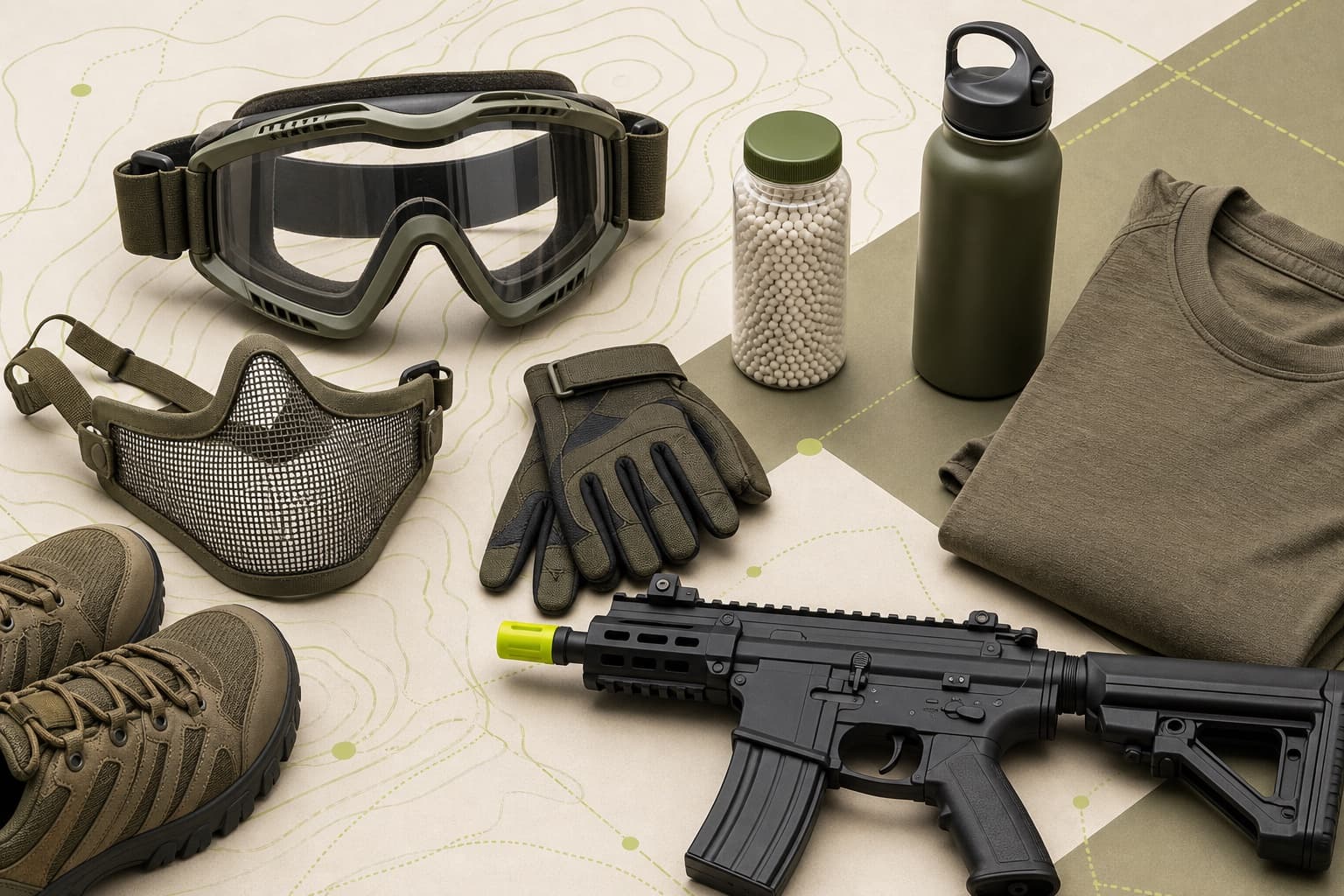
Safety first. Always check the field rules and organiser's instructions before buying or using any equipment.
Choosing a first airsoft replica is harder than it looks. Two models at a similar price can lead to very different ownership experiences: one may be light and easy to repair; another may include excellent electronics but depend on an expensive proprietary module; a third may feel indestructible yet arrive above the energy limit of your local field.
This guide does not crown a winner based on muzzle velocity, metal content or the number of programmable modes. We have focused on what matters during the first year: value, handling, magazine availability, power adjustment, documentation, spare parts and repairability.
The short answer is that an M4- or AK-style AEG remains the most sensible first purchase for most players. The exact choice depends on budget, the weight you can comfortably carry and the technician or retailer who will support it when the first wear item fails.
How we selected these replicas
We used six practical criteria rather than marketing claims.
Out-of-box operation
A beginner replica should be ready to play without an immediate upgrade list. It needs an adjustable hop-up, reasonable trigger response and consistent feeding from readily available magazines.
Handling
Weight, length and balance matter more after four hours than during five minutes in a shop. A light, medium-sized carbine normally works across woodland, urban and CQB fields.
Repairability
A familiar architecture, manual, exploded diagram and identifiable references reduce the cost of a fault. Version 2 and Version 3 gearboxes are widely understood, although a proprietary optical ETU can limit that advantage.
Total ownership cost
The replica is only part of the budget. You also need a battery, balance charger, additional magazines, BBs, protection and transport. Proprietary magazines or an unusual battery compartment can turn a cheap purchase into an expensive platform.
Field compatibility
A quick-change spring helps match field energy rules. A new replica should still be chronographed using the BB weight and procedure required by the organiser; the number printed by a shop is not a guarantee.
Support and documentation
We favour manufacturers that publish manuals, exploded diagrams and part references. A component that can be identified and ordered is better than a fault described only as “something in the gearbox”.
The shortlist
| Replica or family | Best for | Main strength | Main compromise |
|---|---|---|---|
| Specna Arms EDGE 2.0 | Best overall balance | ORION V2, GATE ASTER and ESA2 | More weight and electronics to learn |
| Arcturus LWT MK-II CQB ARC SE | Players prioritising low weight | About 2.1 kg, hybrid V2 and quick spring | Arcturus-specific optical ETU |
| G&G CM16 Raider L 2.0E | A proven, documented M4 | Simple handling, ETU, MOSFET and diagrams | Less modern design than some rivals |
| Double Eagle M904G Falcon 3.0 | Tight budget with electronic response | Light, compact and factory ETU | Falcon is the least universal component |
| CYMA CM.040C | Players who want a durable AK | Metal construction and familiar AK gearbox | May need power adjustment and is heavier |
| Tokyo Marui MP7A1 GBB | CQB and a first gas platform | Compact, effective hop-up and recoil | Expensive magazines, maintenance and cold-weather limits |
| ASG CZ Scorpion EVO 3 A1 | Premium compact option | Excellent controls and quick spring | Proprietary magazines and mechanism |
This is not an absolute ranking. The best purchase is the one available with a warranty, appropriate power and competent local service.
Guide prices and a realistic starting budget
Prices vary by colour, length, power configuration, stock and promotion. The ranges below are market references checked at Spanish and European retailers, including VAT, rather than fixed quotations. “Ready to play” adds a suitable battery, a safe balance charger and, where needed, two or three extra magazines. It excludes eye and face protection, BBs, transport and field fees.
| Replica | Guide price for the replica | Guide budget ready to play |
|---|---|---|
| Specna Arms EDGE 2.0 | €269–330 | €310–390 |
| Arcturus LWT MK-II CQB ARC SE | €169–185 | €225–250 |
| G&G CM16 Raider L 2.0E | €198–245 | €245–310 |
| Double Eagle M904G Falcon 3.0 | €135–170 | €180–230 |
| CYMA CM.040C | €260–300 | €300–370 |
| Tokyo Marui MP7A1 GBB | €350–380 | €480–570 |
| ASG CZ Scorpion EVO 3 A1 | €410–470 | €500–600 |
Always compare the complete manufacturer reference. A cheaper Scorpion EVO Sportline, for example, is not the same replica as the EVO 3 A1 Proline recommended here. Magazine cost also matters: the EVO uses proprietary magazines, while some EDGE 2.0 packages already include two mid-caps.
Specna Arms EDGE 2.0: the best-balanced option
EDGE 2.0 is our general recommendation when the budget reaches beyond a basic AEG. We would choose barrel length according to the actual fields: a short or medium model is normally more versatile, while a longer front end adds weight without guaranteeing more range.
Specna Arms lists a metal body, ORION gearbox, 6.03 mm barrel, high-torque motor, flat hop-up, GATE ASTER and ESA2 spring access. The system allows spring removal through the buffer tube without opening the gearbox.
Guide price: €269–330 for the replica, depending on the exact variant. Current Spanish listings range from €268.95 for the SA-E12 EDGE 2.0 to around €330 for other configurations. We estimate €310–390 to make it field-ready; some versions include two mid-caps but no battery or charger.
Handling: EDGE 2.0 is a family rather than a single configuration. For a first replica we would choose an 8–12 inch handguard and a conventional stock with useful battery space. The metal body adds rigidity but makes many variants more tiring than a polymer M4. Compare the exact reference weight rather than a visually similar EDGE model.
Battery, magazines and setup: the M4 format makes mid-caps, pouches and parts easier to find, although feeding and fit should still be tested. ASTER supports sensitivity, precocking and other parameters; a conservative setup is better at first. Aggressive precocking and unnecessary active braking add stress and heat without teaching better fieldcraft.
First-year checks: inner-barrel cleanliness, hop rubber, motor height and trigger-sensor operation. Double cycling, shutdowns or electronic warnings should lead to battery and ETU diagnosis before random spring or gear changes.
It works for beginners because it already delivers the trigger response and electronics that many owners later add as upgrades. M4 ergonomics, magazines and the familiar V2 architecture make support easier. Mechanical repairability is good, while the supported GATE electronics are still more complex and expensive than a basic trigger circuit.
We would skip it when low weight is the priority, the ASTER functions will never be used, or the higher price would reduce the budget for eye protection, batteries and a safe charger.
Arcturus LWT MK-II CQB ARC SE: light and field-ready
The ten-inch LWT MK-II is a serious candidate when handling matters most. Arcturus explicitly positions the Sport line for beginners and lists a minimum configuration weight of about 2.15 kg.
It uses a reinforced-polymer receiver with metal inserts, a hybrid V2 gearbox with quick spring access, 18:1 gears, rotary hop-up, Deans connector and an M4-pattern magazine. ARC SE electronics provide active braking, precocking, programmable modes, battery protection and an electronic fuse.
Guide price: €169–185 for the replica. Spanish listings include €169 at Airsoft Canarias and €179 at Armasur. A sensible package with battery and balance charger is approximately €225–250.
Handling: its roughly 2.15 kg weight is noticeable during repeated shoulder transitions and long holds. The MK-II mock suppressor extends overall length to 782–864 mm, so it is light but not as short as the CQB name may imply. Try it with the stock set to your normal position before assuming it will be ideal around doorways.
Battery and controls: Arcturus lists 7.4 or 11.1 V LiPo/Li-ion batteries with Deans, but physical battery dimensions still matter. Start with the voltage recommended for the supplied spring and local configuration. Burst, binary and precocking are optional capabilities, and a field may prohibit some modes.
First-year checks: front-end fasteners, hop adjustment, motor sound and optical-ETU behaviour. Moisture, dirt or an unsuitable battery can resemble a mechanical fault.
The low weight, modern controls and standard magazine format make it easy to live with. Repairability is reasonable, but its hybrid gearbox and optical ETU should not be treated as completely generic V2 parts. Confirm that the retailer or technician can source the electronic module before buying.
G&G CM16 Raider L 2.0E: established and documented
G&G's Combat Machine family has long been associated with beginner AEGs. The Raider L 2.0E adds an electronic trigger and MOSFET without turning the platform into an unnecessarily complicated project.
The official G&G specification lists polymer, aluminium and metal construction, a weight of 2.3 kg, 750 mm length, a 357 mm inner barrel and a 450-round magazine. G&G also publishes a manual and exploded diagram for reference EGC-16P-R2E.
Guide price: €198–245 for the replica. We found it at €198.40 from Airsoft Yecla, while European prices reach roughly €220–245 depending on promotions. Allow €245–310 for a battery, balance charger and several mid-caps.
Handling: 2.3 kg and 750 mm make a stable general-purpose carbine. The 357 mm inner barrel does not automatically create greater range; seal, hop rubber, adjustment and BB quality matter more. Its polymer body keeps weight below many metal M4s while retaining a conventional stock with more practical battery room than a PDW design.
Battery and magazines: the included 450-round magazine is a high-cap. Several tested mid-caps reduce noise and make ammunition management easier. ETU and MOSFET improve response, but battery voltage and programming should follow the exact manual rather than advice for an older CM16.
First-year checks: magazine fit, motor adjustment and stock wiring. The official diagram helps distinguish Raider 2.0E parts from earlier CM16 generations that look similar but do not share all electronics.
It is easy to understand, M4 magazines are common, and many technicians know the CM16 family. It may not provide the largest specification list per euro, but documentation and market history improve the ownership experience.
Double Eagle M904G Falcon 3.0: strong features on a tight budget
The M904G is one of the least expensive routes into a compact AEG with electronic control. Falcon 3.0 retains the light nylon body and adds a programmable ETU.
The current European listing describes a weight of roughly 2 kg, a length of 625 mm and selectable power configurations. The battery is not included, and the compact stock has limited space, so battery dimensions must be checked.
Guide price: €135–170 for the replica on the European market. A realistic €180–230 ready-to-play budget covers a battery that actually fits the stock, a balance charger, two mid-caps and some allowance for shipping from another EU country.
Handling: it is the shortest M4 in the selection, and the nylon receiver keeps the centre of mass close to the player. An ambidextrous selector, enlarged magazine release and adjustable stock work for right- and left-handed users. Low weight should not be mistaken for the feel or rigidity of a full-metal body.
Internals: the Falcon 3.0 listing specifies a V2 gearbox, quick spring access, steel gears, 8 mm bearings and rotary hop-up. Falcon adds trigger sensitivity, burst, binary and precocking plus overload protection. We would begin with ordinary semi and automatic modes and conservative or disabled precocking.
Battery and magazines: the Deans-connected PDW compartment favours compact packs, so measure shape as well as voltage and capacity. The included magazine is a high-cap, while many AR magazines can work after actual fit and feeding tests.
First-year checks: Falcon configuration, motor temperature, stock wiring and hop stability. A non-responsive ETU should prompt checks of the battery, connector, programming and sensors before opening the gearbox.
Its handling and feature-to-price ratio are excellent. Repairability is mixed: much of the mechanical architecture is familiar, but the Falcon unit is the decisive and least universal component. We would only buy it from a seller that can provide clear Falcon support.
CYMA CM.040C: the robust AK choice
The CM.040C makes sense for players who prefer AK ergonomics and accept additional weight. CYMA-pattern magazines and parts are widely available, and many technicians know the platform.
CYMA's official catalogue entry identifies a metal 6 mm replica with a metal gearbox and 500-round magazine. Its published 393–426 FPS range is an important warning: the exact unit must be chronographed and adjusted if necessary before field use.
Guide price: €260–300 for the replica at European retailers; one current listing is €259.95 at Sissos. We estimate €300–370 with battery, balance charger and mid-caps. A spring change or power adjustment for local field limits can increase that total.
Handling: the folding stock reduces transport length, but it does not remove the weight of a metal front end. Forward balance can feel steady from a supported position and tiring during long ready holds. The large selector lever and rock-and-lock magazine insertion differ from an M4 and are worth practising with gloves.
Mechanism and magazines: V3 is a widespread, robust architecture, but spring access is less convenient than on the modern quick-change M4s here. The 500-round high-cap offers capacity; several mid-caps reduce rattle and teach reloads. AK magazines vary in lug dimensions, height and feeding between manufacturers.
First-year checks: front-end fasteners, top-cover retention, stock play, magazine feeding and hop adjustment. After wet games, dry and protect steel screws and components against corrosion.
The familiar V3 gearbox and solid construction support long ownership. Spring access is usually less convenient than on modern quick-change M4s, and external AK parts are not universally interchangeable, so the exact CM.040C variant still matters.
Tokyo Marui MP7A1 GBB: a compact route into gas
Tokyo Marui's MP7A1 GBB belongs in this selection because it offers a compact gas platform for less than many full-size GBB rifles. It is not the cheapest replica in the guide or the easiest to maintain, but it is one of the most manageable ways to experience recoil, bolt-catch operation and realistic-capacity magazines in CQB.
It should not be confused with Tokyo Marui's electric MP7A1 or the VFC versions. The official MP7A1 GBB specification lists semi and automatic fire, adjustable hop-up, a 146 mm barrel, 2.2 kg weight with an empty magazine, 381–586 mm length and a 40-round gas magazine. Tokyo Marui also publishes the official manual with exploded parts and references.
Guide price: €350–380 for the replica. A current Spanish listing is €369.99 at Tactical Center, with other Spanish retailers around €379 and sale prices close to €350. Magazines are the important extra cost: an original currently costs about €55. With two or three extras, gas and basic consumables, allow €480–570.
Handling and field use: the retractable stock and short front end work particularly well inside buildings, vehicles and tight cover. Blowback gives physical feedback that an AEG cannot reproduce, while the 40-round magazine requires deliberate ammunition management. It is heavier than the electric MP7 and needs far more frequent reloads than an M4 using mid-caps.
Gas and temperature: Tokyo Marui designs the system around moderate-pressure gas. We would not automatically use the strongest available gas in summer, because excess pressure increases wear and can damage internal parts. In cold weather, falling pressure weakens recoil and may prevent a full cycle, so it cannot match an AEG's year-round consistency.
Maintenance and repairability: seals, barrel, valves and friction points need suitable products and regular attention, while magazines must be stored according to the manufacturer's guidance. The manual identifies many MGG1 references and original spares are available in Spain, but the mechanism and magazines are proprietary. A leaking magazine or damaged nozzle needs more attention than replacing a battery.
When we would choose it: for CQB, for a player who values gas realism and accepts learning maintenance from day one, or as a compact platform alongside an AEG backup. When we would not: as the only replica for winter play, on a strict budget, or when carrying plenty of ammunition without investing in magazines is important.
ASG CZ Scorpion EVO 3 A1: the premium compact system
The Scorpion is different from the other choices. It is not attractive because it uses universal components; it is attractive because it was designed as a complete system.
The official ASG page lists an ECU, quick-change spring, empty-magazine stop, bolt-catch operation, genuine three-round burst, T-Plug and adjustable hop-up. It weighs 2.3 kg, measures 425–625 mm and uses proprietary 75-round magazines. ASG publishes both a manual and component drawing.
Guide price: €410–470 for the Proline replica. Spanish pricing starts at €410 from Armasur, with other European shops around €420–470. Once the recommended battery, a balance charger and enough proprietary EVO magazines are included, a realistic starting budget is €500–600.
Handling: it is the shortest option with its stock folded and concentrates controls around the grip. Its 2.3 kg in a compact body feels dense and stable rather than toy-like. Try stock length and sight height while wearing lower-face protection before purchasing.
Battery and magazines: ASG recommends an 11.1 V 1,000 mAh T-Plug LiPo for this reference. The 75-round magazines operate empty-magazine detection, which is useful but ties the function to EVO magazines. A full game load requires several, so include their cost in comparisons with M4 platforms.
Internals: the ECU and gearbox were designed for the EVO. This enables bolt-catch operation, empty stop and genuine burst but requires exact EVO references for repairs. Quick spring access helps power adjustment, while the listed 1.44 J version may still need changes for a particular field.
First-year checks: magazine feeding, bolt catch, connectors, selector and ECU warnings. Do not bypass empty detection or fit merely similar-looking components without the exploded diagram.
Handling and electronic control are excellent, and it can remain a player's only replica for years. Repairability is good when EVO service and parts are available, but worse than a V2 M4 when the plan is to use generic parts. Proprietary magazines, ECU and gearbox increase total ownership cost.
What about the standard Tokyo Marui M4A1?
The standard Tokyo Marui electric M4A1 remains a benchmark for factory setup and documentation. It has adjustable hop-up and a huge established ecosystem. Its current specification, however, still uses an 8.4 V Ni-MH battery, weighs 2.95 kg with battery and lacks the quick spring access and modern electronics found in newer competitors.
Guide price: €190–230 for the standard replica when it is available in Europe; the Tokyo Marui European shop lists it at €189.90. Allow roughly €250–320 for the compatible Ni-MH battery, its charger and additional magazines. Do not confuse it with the gas M4A1 MWS, recoil-equipped NGRS or new EVOLT, all of which cost considerably more.
In practice it is long and heavy beside the M904G or Arcturus, but its balance and traditional controls are predictable. It includes a 68-round mid-cap and clearly documented battery system. Its virtue is not a long feature list; it is a conservative setup that needs no programming.
Repairability benefits from documentation and accumulated technician experience, but “M4 compatible” never means that every modern component fits without work. We would not buy it to immediately add a strong spring, high-voltage LiPo and replacement electronics, because that removes the factory coherence that makes Tokyo Marui attractive.
It is a valid choice for players who value traditional mechanics and Tokyo Marui documentation. We do not place it at the top of the European value ranking because part of the budget buys a more classic platform that may need its power and battery setup adapted to current preferences.
What we would buy for each player
- One versatile primary: a short or medium Specna Arms EDGE 2.0.
- Lowest practical weight: Arcturus LWT MK-II CQB ARC SE.
- A familiar M4 without chasing programmable features: G&G CM16 Raider L 2.0E.
- Very tight budget and CQB priority: Double Eagle M904G Falcon 3.0, after confirming ETU support.
- A clear preference for AKs: CYMA CM.040C supplied at a verified field-appropriate power.
- A compact first gas platform for CQB: Tokyo Marui MP7A1 GBB, budgeting for magazines, gas and maintenance from the start.
- Higher budget for a complete compact platform: ASG CZ Scorpion EVO 3 A1.
Checks before paying
Do not buy from the family name alone. Similar listings can refer to different generations, electronics or power configurations.
- Ask for the complete manufacturer reference.
- Confirm measured energy and whether adjustment affects the warranty.
- Check battery dimensions, connector and whether a charger is included.
- Price two or three additional magazines.
- Find the manual, exploded diagram and common wear parts.
- Ask who handles warranty work and electronic repairs.
- Hold the replica with protection and accessories similar to your game setup.
- Check field rules and applicable local requirements before transport or use.
Final recommendation
Without a strong preference, we would choose a short or medium M4 AEG. Specna Arms EDGE 2.0 offers the best overall package when budget allows; Arcturus LWT MK-II stands out when weight matters; and the Double Eagle M904G is hard to ignore on a limited budget with proper Falcon support.
CYMA CM.040C is the sensible AK alternative in this selection. The Tokyo Marui MP7A1 GBB is the specialist CQB choice for players who prioritise the gas experience, while the Scorpion EVO is a premium purchase made with full knowledge of its proprietary components.
Do not upgrade any of them before several game days. Adjust the hop-up, use good BBs and learn the replica's behaviour. Let a real need—not an internet parts list—decide the first modification.
Compare systems in our replica catalogue, consult the manual library, and find airsoft fields in Spain before deciding where you will play.