Safety first. Always check the field rules and organiser's instructions before buying or using any equipment.
A gas blowback replica works through a balance of seals, valves, moving parts and controlled friction. It does not need to be soaked in oil after every game. It needs regular inspection, careful cleaning and the right product in the right place.
Always follow the manufacturer manual for your exact model. This guide covers general workshop practice for GBB pistols and GBBR rifles, not a substitute for model-specific instructions.
When maintenance is needed
Perform a quick check after every game and a more complete clean after dusty or wet use, after several game days, or when cycling becomes slow or inconsistent. Investigate immediately if a magazine leaks, the nozzle sticks, the slide or bolt fails to return, or accuracy suddenly changes.
More lubricant is not preventive maintenance. Excess oil attracts dirt, reaches the hop-up and can reduce accuracy. The objective is a clean mechanism with a very thin film only where friction or sealing requires it.
Make the replica safe
Remove the magazine, clear the chamber and confirm that no BB remains. Release gas only in the way recommended by the manufacturer and never point a valve at your face. Work in a ventilated area away from flames, heat and ignition sources. Wear eye protection when handling springs, valves and pressurised magazines.
Use a clean tray so that pins, springs and O-rings cannot disappear. Take reference photos before removing assemblies if the manual does not show every orientation.
Products and tools
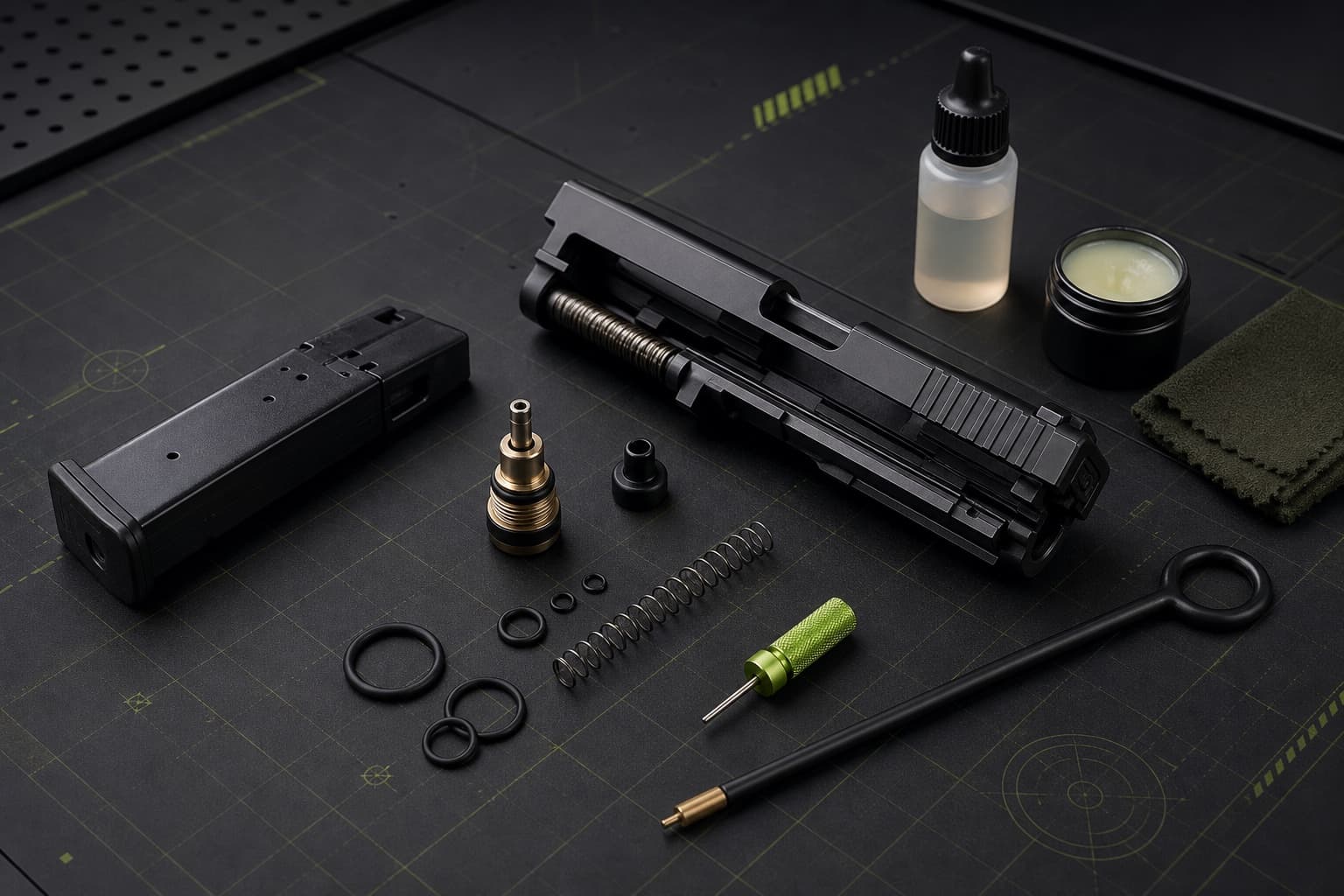
You normally need lint-free cloths, cotton swabs used carefully, a cleaning rod, non-shedding patches, a soft brush, silicone oil suitable for airsoft seals and a light synthetic or PTFE-compatible grease for specified metal contact surfaces.
Abbey products commonly used by players include Silicone Gun Oil for seals and moving polymer-safe points, Silicone Gun Grease for applications that need a grease rather than a fluid oil, and Maintenance Gas for periodic seal care. Product names and formulations can change, so read the current label and the replica manual before use.
Never use penetrating oil, general-purpose petroleum spray or an unknown solvent. Some products swell or degrade rubber and plastic. Do not put lubricant inside the inner barrel or on the hop-up rubber.
Cleaning the inner barrel
Turn the hop-up down if the manual recommends it. Use the correct cleaning rod with a clean, dry patch and stop before the patch can catch the hop-up rubber. Pass it gently until it comes out clean. Do not force a jam with a sharp metal tool.
If accuracy remains poor, inspect the hop-up rubber for oil, dirt, tearing or poor alignment. Reassemble and test the hop adjustment gradually with the BB weight you normally use.
Slide, bolt and nozzle
Remove loose dirt with a cloth and soft brush. Inspect slide or bolt rails, contact surfaces, return springs and stops for unusual wear. Apply only a thin film of the lubricant specified for that material. Wipe away any visible excess.
The nozzle must move freely without cracks or deformation. Check the piston seal and return spring without stretching them. A sticky nozzle can be caused by dirt, a damaged seal, poor alignment or an incompatible product; adding more oil may hide the symptom without fixing the cause.
Understanding a gas-magazine valve
A typical magazine has an inlet valve for filling and an output or release valve that meters gas into the replica. Each valve body contains a moving stem and one or more O-rings that seal against the body. The magazine also has a main shell, base seal and feed lips.
If a leak is heard at a valve, first identify its exact source with a safe leak test. Do not overtighten the valve: that can crush an O-ring or damage the thread. Depressurise the magazine as instructed, remove the valve only with the correct tool, inspect the O-ring and apply a minimal amount of compatible silicone product before reassembly. Replace cut, flattened or swollen seals with the correct size.
Magazine care and storage
Keep the fill valve clean and align the gas bottle correctly while filling. Do not hold the release valve to dump a full magazine rapidly; the cold and pressure change can damage seals. Protect feed lips from impacts and do not use the magazine as a grip when it strains the catch.
Many green-gas magazines are stored with a small amount of gas so the seals remain seated, but follow the manufacturer instruction for your model. CO₂ capsules should generally not be left installed for long storage. Keep magazines away from direct sun, vehicles in summer and other high-temperature areas.
Diagnosing common problems
A leak at the fill valve: check for dirt, bottle alignment, the valve O-ring and correct seating.
A leak at the output valve: inspect the stem seal and valve tightness with the proper tool.
A leak from the magazine body: inspect the base seal and shell for damage.
Weak cycling: consider temperature, gas choice, magazine temperature, friction, nozzle seal and return springs.
Poor accuracy: clean the barrel and hop-up; lubricant contamination is a frequent cause.
Failure to lock back: inspect the follower, bolt-stop interface, gas pressure and model-specific wear points.
Mistakes to avoid
- Flooding the mechanism with silicone oil.
- Spraying oil through the barrel.
- Using automotive or general-purpose petroleum products.
- Overtightening valves and screws.
- Mixing parts from different brands or generations because they look similar.
- Disassembling a pressurised magazine.
- Testing a replica without eye protection.
A simple maintenance schedule
After each game, wipe exterior dirt, check the barrel, inspect magazines for leaks and store everything dry. Every few game days, clean rails and moving assemblies, inspect the nozzle and seals, and apply minimal lubrication where specified. Before long storage, clean the replica, care for magazines according to the manual and keep gas and batteries in safe conditions.
Record the exact model, generation and part references before ordering replacements. The replica catalogue and official manuals library can help you find model-specific documentation. If a fault involves a damaged pressure-bearing part or you are uncertain about reassembly, use a qualified technician.